Topics of Interest
|
Process engineering |
|
Advanced control in industry |
|
Safety system |
|
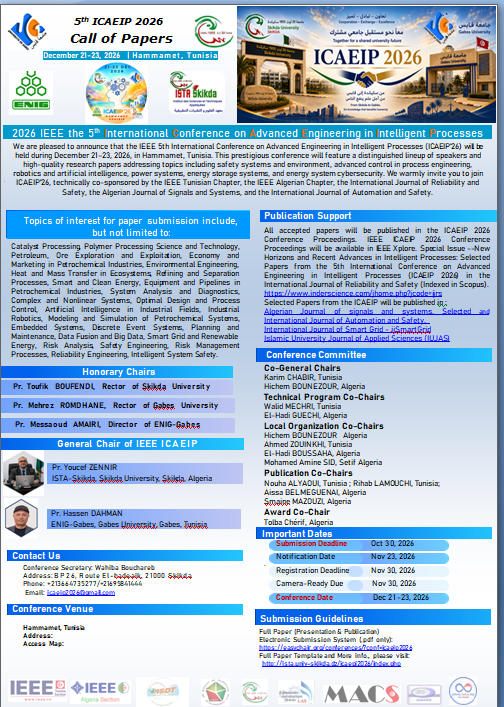
1. Catalyst processing 2. Polymer Processing Science and Technology. 3. Petroleum, Ore exploration and exploitation 4. Economy and marketing in petrochemical industries 5. Environmental Engineering 6. Heat and mass transfer in the ecosystems 7. Refining and separation processes 8. Smart-Clean energy 9. Equipment and Pipelines in petrochemical industries |
|
1. Analysis and diagnostics of systems 2. Complex and nonlinear Systems 3. Optimal design and Process control 4. Artificial intelligence in industrial fields 5. Industrial Robotics 6. Modeling and simulation of Petrochemical systems 7. Embedded Systems 8. Discrete Events Systems 9. Planning and maintenance 10. Fusion data and Big data 11. Smart grid and renewable energy |
|
1. Risk analysis 2. Safety engineering 3. Risk management process 4. Reliability engineering 5. Intelligent system safety
|
Problem Statement of the conference
|
Industry is becoming increasingly complex, both in terms of its scale and the diversity of its functions and objectives. Today, industries face major challenges, including resource optimization, productivity enhancement, and environmental protection. In this context, Artificial Intelligence (AI), automation, industrial hygiene, and safety have emerged as key areas of interest, and their importance continues to grow across various industrial sectors. Over the past decades, advanced engineering has witnessed remarkable progress through the development of innovative technologies and methodologies aimed at achieving optimal production performance while ensuring environmental sustainability and operational safety. These advancements have significantly transformed industrial processes and management practices. The organization of the Fourth International Conference on Artificial Intelligence, Automation, and Environmental Protection in Industry (ICAEIP’26) provides an excellent opportunity for academics, researchers, engineers, and industry professionals to exchange knowledge, share experiences, and discuss the latest scientific and technological developments. The conference aims to help participants stay informed about cutting-edge technologies and contribute innovative solutions to existing industrial challenges. |
Submissions & Publication Guidelines
Papers should describe original and unpublished work about the above or related topics. All manuscripts will be reviewed by three members of the program committee. Authors are invited to submit their papers in English of up to 6 double-column pages IEEE format, with up to 2 extra pages with additional fees. The format of the paper should follow IEEE guidelines for the two-column IEEE-sponsored conference proceedings. Templates for Microsoft Word and LaTeX are available here . Only papers that have not been published or presented in any way will be accepted for ICAEIP 2026.
How to submit
Authors need an active CMT account before attempting a submission. Create one at https://cmt3.research.microsoft.com/docs/help/general/account-creation.html and consult the author submission instructions.
CMT acknowledgment
The Microsoft CMT service was used for managing the peer-reviewing process for this conference. This service was provided for free by Microsoft and they bore all expenses, including costs for Azure cloud services as well as for software development and support.
Note: The conference submission system only accepts manuscripts in PDF A4 format (before the revision manuscripts do not have to be checked by IEEE PDFXpress).
Where to submit
Papers should be submitted online to:
https://cmt3.research.microsoft.com/ICAEIP2026
Please do not send papers by email or use any other platform.
Authors must submit original work not published before or not considered for publication elsewhere. They are required to explicitly explain the difference between their contribution and the current state-of-the-art (including their previous work). In the related works section, the authors must discuss and compare the state-of-the-art approach against what they are proposing in their paper and emphasis the novelty of the presented works. The authors also have to discuss the technical limitation of their approaches and provide an unbiased opinion about the advantages and disadvantages of their approach.
Plagiarism is strictly prohibited, and any serious plagiarism case will be automatically discarded from the conference program without any review.
Technical consistency is a mandatory acceptance prerequisite. It's the authors' duty, with whatever means the authors consider appropriate, to persuade examiners of the technical correctness of their article. To increase confidence in practical and theoretical findings and enhance their reusability, we encourage open source projects as well as computerized proofs. The authors have to provide all the assumptions made in their approach and discuss the implication of these assumptions in the obtained results. Experimental settings must be described with all details that allow the reader to be able to reproduce the experiments and verify the results.
The quality of writing is of great significance. A paper that is poorly written will be likely considered as reject by the reviewer even if it provides a good contribution. To ensure the reader accurately understands and evaluates the technical contribution, this paper needs to be well structured and written. We hope that the authors will update their text and reduce the number of typos and grammatical errors. It is recommended to use professional automated tools for proofreading the paper before submission.Acknowledgments.